
Sustainability in Hospitality Print
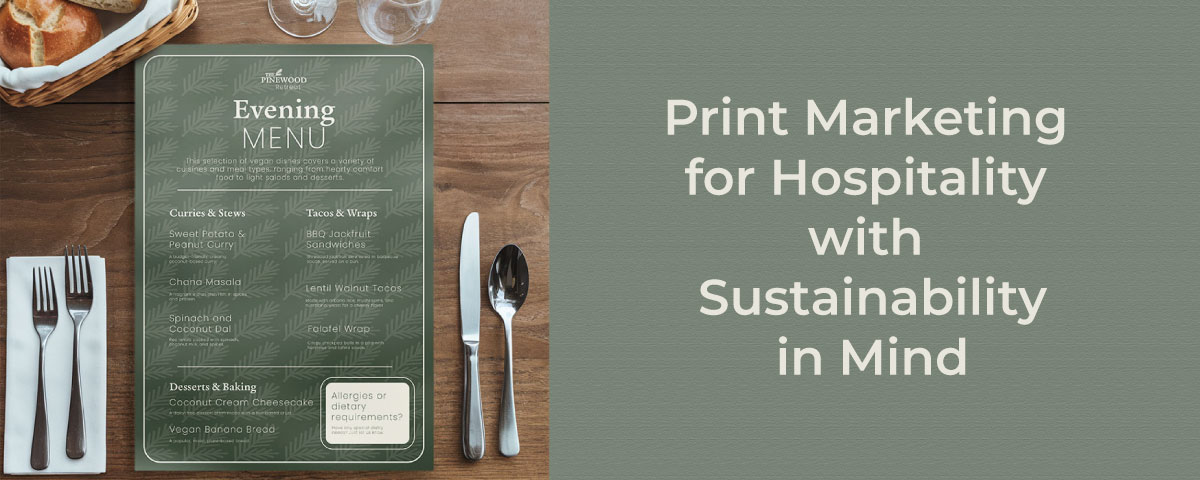
Choose a Print Partner That Supports Your Environmental, Social, and Governance Goals
Sustainability is a non-negotiable in hospitality businesses. At any boutique hotel, restaurant group, pub chain or event venue, customers increasingly expect environmental responsibility to be embedded throughout the guest experience.
While much attention is given to food sourcing, energy consumption and waste reduction, print has previously remained an overlooked part of a hospitality business's sustainability strategy.
Menus and promotional materials,signage, packaging, loyalty cards and event collateral all count and print plays a significant role in both operations and brand communications. Choosing the right print partner can help hospitality businesses reduce environmental impact, strengthen ESG credentials and meet the expectations of customers who increasingly demand to know the environmental impact of the venues they choose.
One very important question for us, is always: how do you separate genuine sustainability from “green marketing”? Greenwashing, exaggerating or misrepresenting environmental benefits, is real and damaging, and avoiding it is exactly why we focus on evidence rather than broad claims. We prefer to assess specific environmental merits, looking at the evidence behind them and our overall direction of travel. Making measurable progress and being reasonably transparent about its impact is our main objective.
Sustainable Print For Hospitality
The hospitality industry relies heavily on printed materials to create memorable guest experiences.
Hotels use printed welcome packs, room information and event brochures. Restaurants and cafés depend on menus, table talkers and promotional materials. Venues and attractions produce everything from tickets and programmes to directional signage and branded merchandise, flyers and posters to raise awareness as part of the marketing mix.
When multiplied across multiple locations or thousands of customers, the environmental impact of these materials can quickly add up.
The good news is that modern print has become significantly more sustainable, with responsible paper sourcing, improved recycling systems and advances in manufacturing efficiency helping to reduce environmental impact throughout the supply chain.
For hospitality businesses looking to improve sustainability performance, print is often one of the easiest areas to review and optimise.
Why Hospitality Businesses Need Sustainable Print Partners
1. Independent Environmental Certifications
One of the first indicators of a credible sustainability programme is third-party certification.
We don't rely on marketing claims; we are a print partner that can demonstrate recognised standards. At Tradeprint, we can share credentials such as:
ISO 14001 certified environmental management
We meet our Extended Producer Responsibility (EPR) obligations and use Valpak’s packaging data to target reductions at source
Continuous waste reduction and process improvement programmes
PVC-free alternatives started across our display ranges with more in scope
Biodiversity contributions through donations to the Scottish Wildlife Trust (alongside, not in place of, reducing our own operational impact)
Ongoing evaluation of materials, processes and suppliers to identify lower-impact solutions
Our sustainability progress, by the numbers
-
Waste diverted from landfill increased to 99.72% for FY26
-
Recycled / recovered material rate: 88.8%
-
Recycled-content paper: 100% of volume
-
PVC-free: available across our banner range
-
Renewable electricity: 36% of site energy
-
Independent assessment: Sustainability Truth Score 76/100 considered good
-
Certifications: ISO 14001; FESPA UK Waste Accreditation 2026
-
Awards: Printweek Innovation of the Year – Business Strategy (2026); Printweek 2025 & 2026 Short-listed Environmental Company of the Year Scottish Green Apple Award; 2 x winner of the IPIA Sustainability Advocate Award
These certifications demonstrate that environmental responsibility is built into our day-to-day operations and monitored through structured management systems.
For hospitality brands with their own ESG targets, working with certified suppliers also helps support procurement reporting and sustainability audits.
2. Lower-Impact Materials for Guest-Facing Print
Hospitality businesses often have a wide range of printed materials in circulation, many of which have traditionally relied on less sustainable substrates.
We are adding new lower-impact substrates and initiatives, including:
-
Recycled paper options
-
Natural materials in uncoated options such as linen, hemp, and uncoated cotton
-
FSC® or PEFC-certified stocks from responsibly managed forests
-
Recyclable display materials such as unlaminated cardboard and Correx
-
Recyclable and recycled-content packaging
-
Product end-of-life recyclability with our Banner Return Scheme
Many hospitality brands are already reducing single-use plastics across their operations. The same thinking should apply to printed materials and signage.
As a supplier actively transitioning away from problematic materials, we are removing PVC from our display ranges as part of an ongoing commitment to continuous improvement. We have been actively including PVC-Free substrates and have a Banner Return Scheme to help make disposal and recycling efficient.
3. Supply Chain Transparency
Sustainability doesn't stop at the print factory door. Hospitality operators increasingly want visibility into the environmental impact of their supply chain, particularly as ESG reporting requirements continue to grow.
For hospitality businesses with ambitious sustainability goals, supply chain transparency is becoming just as important as product quality and price.
Our Sustainability Lead Anthony Rowell has considered transparency and is always happy to provide clear answers, such as:
-
How is sustainability measured?
-
Are environmental impacts independently assessed?
-
How are suppliers selected and monitored?
-
What evidence supports sustainability claims?
We are in the enviable position of having Anthony as our Sustainability Lead within the business. An advocate of print throughout his career, Anthony has embraced and embodied the concept of sustainability. For several years, he has been the Chair of the BPIF Environmental Forum and is a Cambridge Business Sustainability Management Alumni.
4. Responsible Waste Management
Waste reduction is a major focus throughout hospitality operations.
The same principles should apply to print procurement.
As a forward-thinking print supplier, we are implementing programmes that minimise waste through:
-
Efficient production planning
-
Material optimisation
-
Recycling initiatives
-
Packaging reduction
-
Continuous process improvement
Environmental compliance schemes such as Extended Producer Responsibility (EPR) are also becoming increasingly important.
Working with third-party organisations help us demonstrate a proactive approach to managing packaging obligations and improving environmental accountability throughout the product lifecycle.
5. Carbon Reduction and Climate Commitments
Many hospitality brands now publish sustainability reports and net-zero ambitions. We support those goals.
Often the focus can be solely on carbon offsetting, but evidence of genuine carbon reduction initiatives is a better approach, including:
-
Energy efficiency improvements
-
Waste reduction programmes
-
Responsible sourcing policies
-
Manufacturing optimisation
-
Emissions monitoring and reporting
We understand that carbon management can become a valuable partner in helping hospitality businesses reduce their overall environmental footprint.
We have our own take on carbon offsetting and that is, that we prefer to address internal processes to make significant improvements onsite.
Avoiding Greenwashing
Sustainability has become a powerful marketing message, but not all environmental claims are equally meaningful.
Steve Lister's Sustainability Truth Score highlights the importance of evidence-based sustainability, encouraging organisations to move beyond vague promises and demonstrate measurable action.
When Steve Lister assessed Tradeprint against his Sustainability Truth Score, we scored 76/100 in 2026. His feedback: “…the best I have analysed so far for clients!”
Read the Sustainability Truth Score
Hospitality businesses should be cautious of suppliers making broad environmental claims without supporting evidence.
The report highlighted some of our best practice:
-
Published sustainability policies
-
Independent certifications
-
Measurable environmental targets
-
Third-party assessments
-
Transparent reporting
-
Clear examples of environmental improvement
Industry Recognition And Sustainability Awards
Independent recognition provides additional reassurance that a supplier is delivering genuine environmental progress.
Industry organisations such as:
-
BPIF (British Printing Industries Federation)
-
Two Sides
-
The IPIA
All promote higher standards, transparency and continuous improvement across the print sector.
Awards and external recognition can also provide valuable indicators of performance. We have worked hard to gain recognition in print sustainability by way of several prestigious awards:
-
PrintWeek's Innovation of the Year Business Strategy for our work on sustainability
-
The Scottish Green Apple Award from the Green Organisation
To read more about our sustainability efforts and goals you can read our full Environmental Policy.
For hospitality procurement teams, these external benchmarks help separate leaders from followers.
Tradeprint's Commitment to Sustainable Hospitality Print
For us, sustainability is viewed as a long-term commitment rather than a standalone initiative.
As part of Cimpress, one of the world’s leading mass-customisation businesses, we have access to group-level investment and research into lower-impact materials and processes, which we apply directly to the print we manufacture in Dundee.
For hospitality customers, this means access to a print partner that understands the importance of balancing sustainability, brand quality, operational efficiency and customer experience.
Producing menus, event materials, marketing collateral, point-of-sale displays or venue signage now requires sustainability consideration built into every purchasing decision.
Creating a More Sustainable Guest Experience
Today's guests are paying attention, and so are we. They notice recyclable packaging. They value responsible sourcing. They increasingly expect the brands they support to make environmentally conscious choices.
Sustainable print may not be the first thing guests think about when they visit a hotel, restaurant or venue, but it forms part of the wider story your brand tells.
By choosing print suppliers that prioritise transparency, certification, responsible sourcing and continuous improvement, hospitality businesses can strengthen their sustainability credentials while delivering the high-quality experiences customers expect.
Sustainability balances reducing environmental impact with building a business and brand that guests, employees and communities can trust for the long term.
Recent Posts
Categories
- Best Sellers (52)
- How To Guides (31)
- News (31)
- Events (19)
- Charity (16)
- Business (15)
- Hospitality (15)
- Case Studies (14)
- Marketing Materials (11)
- Substrates (10)
- Awards (9)
- Sustainability (8)
- Design (6)
- Election Printing & Direct Mail (6)
- Ask A Print Expert (4)
- Education (3)
- Samples (3)
- Artwork Services (2)
- Tradeprint PRO (2)
Archives
- December 2025 (10)
- July 2026 (10)
- September 2018 (6)
- August 2021 (6)
- May 2022 (6)
- March 2026 (6)
- April 2026 (6)
- January 2023 (5)
- October 2017 (4)
- September 2021 (4)
- December 2021 (4)
- January 2026 (4)
- February 2026 (4)
- August 2018 (3)
- January 2022 (3)
- February 2022 (3)
- March 2022 (3)
- November 2022 (3)
- March 2023 (3)
- April 2023 (3)